Search This Blog

Thursday, 13 June 2013

6/12 - Dai Bosatsu Zendo


                My hosts at Zen Mountain Monastery told me that Dai Bosatsu was on “the other side of the mountain.” Both monasteries are in the Catskills—the mountains where Rip van Winkle fell asleep and woke to find the world, as he had known it, changed. The scenery along the drive, up and over the mountains, is impressive—gently rolling hills in bright green, a high altitude reservoir, creeks and streams, a waterfall that has partially eaten away at the road. An eagle glides alongside the car for a while, almost at the height of my head.
                But when I arrive here, I feel like I’m in another world altogether.
                All things, of course, are relative. I had thought that the Morgan Bay Zendo in Maine was isolated, but to get to Dai Bosatsu on Beecher Lake, one travels along a rough secondary road and then up a gravel road—partially eroded by the persistent rains. I had thought that Zen Mountain Monastery was large—I described it as “huge.” But the front gate for Dai Bosatsu is two miles from the main monastery building. The grounds cover 1400 acres.
                The property is on Beecher Lake. The guest house had been the home of Harriet Beecher Stowe’s brother. It is pretty much what one would expect a wealthy 19th century family to build as their the mountain getaway. But then one comes up to the monastery itself, constructed in traditional Japanese style, and one could believe one had been transported to Kyoto.
                The formalities are Japanese. Lunch is eaten jihatsu, with three nesting bowls and chants in Japanese. Western monks with Japanese Dharma names, wearing Japanese robes, respond with “Hai!” when addressed. There is an altar with incense—and a lighter—in my room and, as far as I can tell, all the rooms. The walls are decorated with calligraphy. There has been a Japanese flavor at the other centers I’ve visited, but nowhere has it been as pervasive as here.
                It is also fair to say that this is the first place I’ve visited where I did not immediately feel at ease.  It is beautiful. It is entrancing. But that’s  part of my problem. It’s exotic. Does the practice, I wonder, benefit from being exotic?
                If I am not entirely at ease with the structure and forms, it is not at all difficult to feel at ease with the abbot—Shinge Sherry Chayat Roshi. She comes to our interview with her dog, Nikita. Throughout the conversation she is relaxed and informal.  She pauses, reflectively, before answering my questions, and her responses are cogent and articulate. She interviews well. One of her students tells me that he sees in her someone who genuinely embodies the Four Vows. The term that comes to my mind is “charming.” She has an infectious grin.
                Her family situation, when she was a child, had been difficult. Her step-father was physically abusive, once taping her mouth shut because he felt she was making too much noise. But she early learned that if she went off on her own and just sat still, with  hands clasped, she could gain a sense of peace otherwise unattainable. In her eighth grade world studies class, there was a unit on Zen Buddhism, and she recognized that what she had been doing was Zen. She had intuitively discovered zazen.
                We go into the zendo at 6:00 for chanting (reciting the lineage back to before Bodhidharma), two forty-five minute periods of zazen, and kinhin—which winds its way down inner and outer corridors—followed by a series of prostrations. As in Morgan Bay, there are no sounds except those of the birds calling. The building is otherwise absolutely silent—so the han, the bells, and the slightly tinny gong have a presence that they might not otherwise. The atmosphere is taut, and it is easy to focus.
                Shinge Roshi refers to Dai Bosatsu as the “gem of North American Zen.” It is the first Rinzai monastery to be established outside of Japan; officially inaugurated in the bi-centennial year, 1976, it had actually been in operation for some five years prior. Aesthetically—regardless of my reservations about the Japanese accoutrements—it is a marvel. And one is conscious of the spiritual power of the place. The atmosphere is enveloping.
                It is a gem. But currently there are only seven people in residence, and one of them will soon be leaving. Sesshin can have as few as fifteen attendees.
                The numbers used to be greater.  Part of the problem is what Shinge refers to as “the troubles”—the revelations of Eido Shimano’s sexual misconduct. Part of it is the fact that this is not an easy place to get to; Zen Mountain Monastery, by comparison, is just down the road from Woodstock (the Woodstock), where there are a plethora of yoga studios and like-minded people. But I also wonder if the “foreignness” of the place isn’t a factor.     
                I find myself torn. The beauty, the atmosphere, the purity of the teaching, the intensity of the practice—none of these are things one would want to see compromised. And yet. . . .
                Shinge Roshi admits that she is still pondering how Japanese or how American the forms should be; she calls it “her koan”—how best to preserve and pass on the teaching she had received. And the truth is that there is something terribly moving in knowing that, morning and evening, people gather in this zendo to recite these chants, sit zazen, and carry out these formalities.

Cypress Trees in the Garden:

Chayat, Shinge Roko Sherry – 69-82, 125, 213, 295

Friday, 7 June 2013

6/7 - Zen Mountain Monastery


                Zen Mountain Monastery is huge.
                First of all, there is the property. 230 acres in the Catskill Mountains. I counted five separate entrance signs along the Plank Road in Mount Tremper, New York.
               The first thing one notices upon driving up the main entrance is an impressive house now listed on the US Register of Historic Places. Originally a Roman Catholic retreat center, it is a gracious structure with vaulted inner stairways and elaborate ironwork on the doors and windows. One door hinge portrays a mother robin feeding a worm to her young. The inside handle to the door leading to the parking lot is in the shape of a grasshopper. For someone whose interest in Asian philosophy was at least partially twigged by David Carradine’s Kung Fu, it seems appropriate. This building now houses the dining hall, the dormitories, and the zendo (which can seat up to 104 participants). A more modern building beside it, only recently completed, is where the offices, lecture hall, and program rooms are found. Its walls are graced with John Daido Loori's photographs. There are cabins and A-frames for residents; there are three hermitages on site--and a graveyard (nothing says you are established in a location like a functioning graveyard).
                But even more significant is the scope of programming offered here. There is a traditional monastic residential program, of course. But there is also a series of programs which bring Zen out of the Zendo and into the wider world. Retreats are given on water-colors, archery, pottery, story-telling, and photography. Each includes morning and evening zazen. An art course is being registered when I arrive. In the parking lot, there are license plates from Virginia, Montana, Michigan, Ohio.
                Zen Mountain Monastery is part of the Mountain and Rivers Order founded by John Daido Loori, one of Taizan Maezumi’s heirs. The order also includes the Zen Center of New York, the Zen Environmental Studies Institute, Dharma Communications, and the National Buddhist Archives. Their promotional material states that the order is based on the “Eight Gates” of Zen developed by Loori:


  • zazen
  • the student-teacher relationship
  • liturgy
  • art practice
  • body practice
  • Buddhist studies
  • work practice
  • right action


                “Grounded within a rigorous monastic matrix, the Eight Gates training emphasizes practice, realization, and actualization of our true nature.”
                The abbot is Konrad Ryushin Marchaj Sensei. He comes in for our interview soaking wet and muddy because he is currently facilitating another retreat topic: Wilderness Training. The catalog lists the program as “Born as the Earth: Wilderness Skills Training” and goes on to describe it thus: “Learn basic outdoor skills and engage the teachings of the wild in the context of Zen training.” Camping in the wilderness and zazen. Today the participants are learning to cope with unanticipated weather conditions. Did I mention that there is a deluge falling at the moment?—three inches of rain predicted before the storm passes. “They are learning about desire,” Ryushin tells me. “The desire to be dry; the desire for a nice hot cup of tea.”
                He was born in Warsaw and came to the US with his parents at the age of 13. He still has a slight Polish accent. He was a pediatrician and a psychiatrist, careers he gave up in order to become a monk. He does pay his annual fees to keep his medical license but that is essentially to serve the community. “I can write prescriptions if they’re needed, or I can guide people through the labyrinth of medical procedures if they have to go to the hospital.” He admits that his mother had difficulty when his life changed directions. “I went from being ‘my son the doctor’ to being ‘my son the monk.’ It was not easy for her.”
                I ask what drew him to the practice of Zen, and, without hesitation, he replies: “My own pain. Although my life was a success on the surface, I was not a happy human being. I was anxious, dissatisfied.” His girl friend of the time introduced him to Vipassana meditation, and immediately he recognized that meditation provided something which addressed the issues he was struggling with more effectively than did therapy. As befits a person with psychiatric training, he is articulate and detailed in his description of his growing involvement with Zen and monastic life.
                I note the emphasis on Liturgy and Buddhist studies here. They are central, he tells me. “Some people react negatively to the liturgical elements, of course. But they are important to what we do.” This is a very much a Buddhist monastery. Zen is not presented as a practice separate from Buddhism as a faith tradition. People who aspire to be students—rather than participants—are expected to become familiar not only with classical Zen literature but with the Pali Sutras as well. The commitment which prospective students take on is a huge one. And they come—people of all ages, the young, the middle aged—in numbers large enough to support this place. The only source of income is program fees and sesshin fees. Pulling that off is pretty huge as well.

[Note: In January 2015, Ryushin was asked to step down as abbot of ZMM. By his own admission, he had been engaged in "an intimate relationship with someone outside our sangha" thus betraying his partner, "breaking our spiritual union vows and ending our marriage." He also admitted that he had been exploring "shamanic traditions and religions" and that his inclusion of elements of these in his presentation of the Dharma "was irresponsible and might have caused some confusion." Geoffrey Shugen Arnold, the head of the Mountain and Rivers Order, took over the duties of abbot at the monastery.]

Cypress Trees in the Garden:
Arnold, Geoffrey Shugen – 262, 266
Loori, John Daido – 65, 224-25, 228, 232, 239, 251-269, 274, 280, 418-19, 476
Marchaj, Konrad Ryushin – 14, 258, 262, 268
Zen Mountain Monastery – 13-14, 20-22, 224-25, 251-69, 419

Thursday, 6 June 2013

6/5 - The Morgan Bay Zendo


            The original Zen (Chan) teachers in China were difficult to access. Their temples were hidden away in the mountains, intentionally located far from larger population centers. Nor were they welcoming. Prospective students who found their way to the temple gates could be refused entry for days on end in order to test their sincerity. In the early 1970s, something similar was happening in a remote coastal village in Maine.

            Walter Nowick was a Julliard-trained musician who was also the first American authorized to teach in the Rinzai School. Before Robert Aitken finished his training under Yamada Roshi and before Philip Kapleau set up shop in Rochester, Nowick had completed the koan curriculum under Zuigan Goto at Daitokuji and returned to a farm his family had purchased for him on the Morgan Bay Road outside of Surry, Maine.

            Gradually people heard about him and made their way to the farm. “There was a tree by the old farm house,” Hugh Curran tells me. The routine was that students would stand by the tree and wait for Walter to acknowledge them. Generally he would come out and tell them that he didn’t want any more students. If the student was serious, he would not be dissuaded. Curran says that he was accepted after three vigils by the tree.

            Charles Guilford waited two and a half months. “There was no formula,” his wife, Susan,  tells me. The Guilfords remember that potential students were expected to establish themselves in the region and find a way to support themselves before they would be considered for acceptance.

            Curran lives half a mile from what is now known as the Morgan Bay Zendo. The Guilfords live half a mile on the other side of the Zendo. In the mile between their homes, there are several houses on lots notched out of the thick Maine woods most of which were built by students who, decades ago, had made their way here to study Zen.

            In 1984, when the Cold War was still waging, Nowick became concerned about the possibility of a nuclear conflict between the United States and the Soviet Union, and he stopped teaching Zen in order to focus on trying to promote understanding between the two nations through a shared appreciation of music. He established the Surry Opera Company and continued to live in the old farm house, until it burned down, but withdrew from active participation with the Zen Community.

            A handful of students decided to maintain the zendo. A board of directors was formed, and they continued—without a resident teacher—to hold regular sits. Teachers from various traditions—Chinese and Korean as well as Japanese—were invited to hold retreats. For almost thirty years, the Morgan Bay Zendo has persisted in this manner.
           
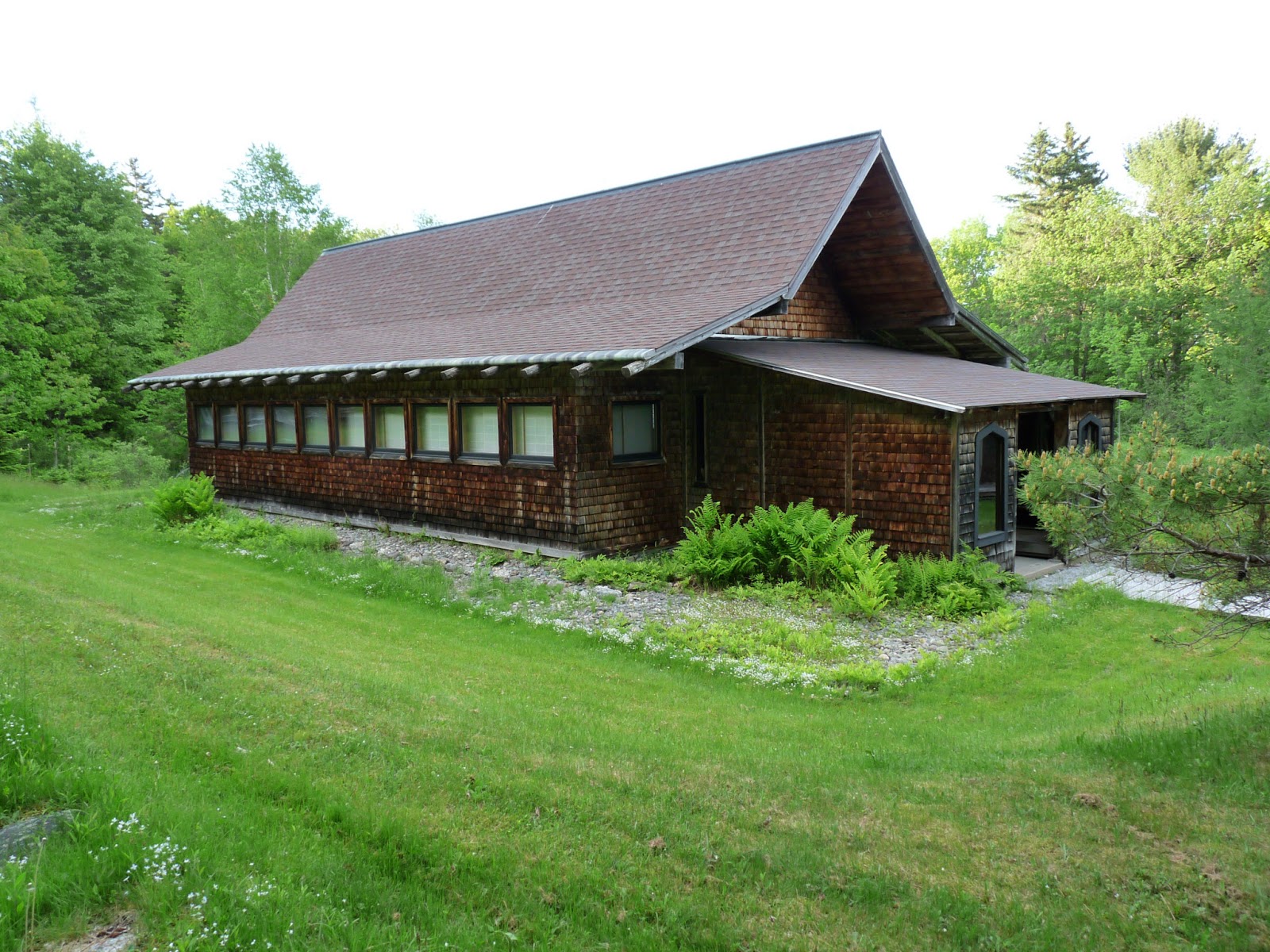
            There is a parking area off the Morgan Bay Road where a small sign identifies the zendo. Practitioners leave their cars here and then make their way down a path through the woods to a clearing where the large, beautiful zendo is situated. The lumber for this—and the other buildings on the site—was harvested from Walter’s land and milled there as well. It is an elegant structure, designed by a student who had built movie sets. The sides of the sloped roof are in two sections, the upper section more sharply angled than the lower, suggesting the curved roofs of some Asian structures.

            Inside, two rows of tans face one another, with seating on each side for 12. The zendo is too far from the road—and the electric heating too costly—to keep it open during the winter months, but, for the other nine months of the year, practitioners still gather here on Sunday mornings to sit. During the summer, there is a shorter sit on Wednesday evenings as well. I am here for the first of these for this year. Five other sitters come for two zazen periods of 25 minutes with a short rest between.

            It is almost perfectly silent. There are no electric hums. There is no sound of traffic. There is only the chirping and peeps of the frogs in a nearby pond. The building—on a wood path, off a secondary road, in a sparsely populated region of Maine—is something of a miracle. One understands why Walter’s former students struggle to maintain it. But, as Hugh notes, they have had trouble recruiting younger members to ensure the survival of both the zendo and the community.

            There is a large boulder in the woods near the zendo beside which Walter had buried a portion of the ashes of his teacher, Zuigan Goto. Walter died this past February, and, later this year, his ashes will be deposited there as well. The boulder is massive and will persist whatever happens to this property. It would be a shame if the zendo did not persist as well.

Cypress Trees in the Garden: pp. 469-476